
Year-end accounting problems very rarely begin in December.
For professional short-term rental property managers, many of the issues that make closing the books in December and January difficult were created months earlier through unreconciled accounts, inconsistent bookkeeping, inaccurate owner balances, missing expense information, or financial processes that never quite worked the way they were supposed to.
By the time year-end arrives, the problem is no longer simply closing the books. You may be trying to reconstruct them.
That is why the months before year-end are often the best time to evaluate your short-term rental accounting process, clean up outstanding issues, and establish financial workflows that can operate consistently through the end of the year and beyond.
If your accounting process is already creating friction today, waiting until December turns a manageable operational problem into a deadline-driven cleanup project.
A clean year-end is built before year-end.
Financial Year-End Problems Often Start Months Before Year-End
December and January tend to get attention because they bring annual reporting, tax preparation, 1099s, reconciliations, and other deadlines.
But the underlying accounting problems often start much earlier.
For a short-term rental property management company, those issues may include:
- Unreconciled bank or trust accounts
- Inconsistent transaction categorization
- Owner statement discrepancies
- Missing vendor information
- Untracked reimbursable expenses
- Lodging tax discrepancies
- Incomplete 1099 information
- PMS and accounting data that do not align
- Balance sheet accounts that have not been reviewed
- Transactions that nobody remembers well enough to explain
Each issue may look relatively small when it first appears, but the problem is accumulation.
One unexplained trust transaction becomes several. A missed owner expense carries into another owner statement. A reconciliation difference remains unresolved while hundreds of additional transactions are added to the account. Eventually, the accounting team is no longer reviewing the current month. They are trying to understand what happened months ago.
That is the difference between maintaining clean books and reconstructing them.
For property managers, year-end accounting should be the final close of a well-maintained year, not the first time the entire year receives a detailed review.
Why Fall Is the Right Time to Start
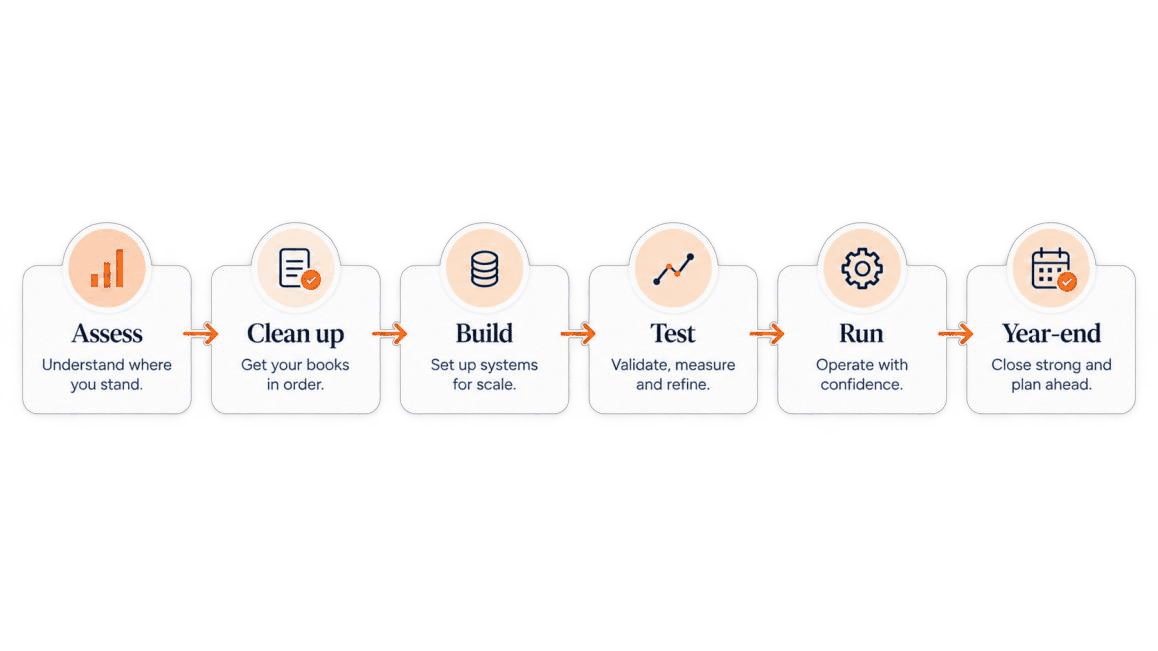
The best time to prepare for year-end accounting is several months before December.
Starting early gives your team enough time to move through a deliberate process:
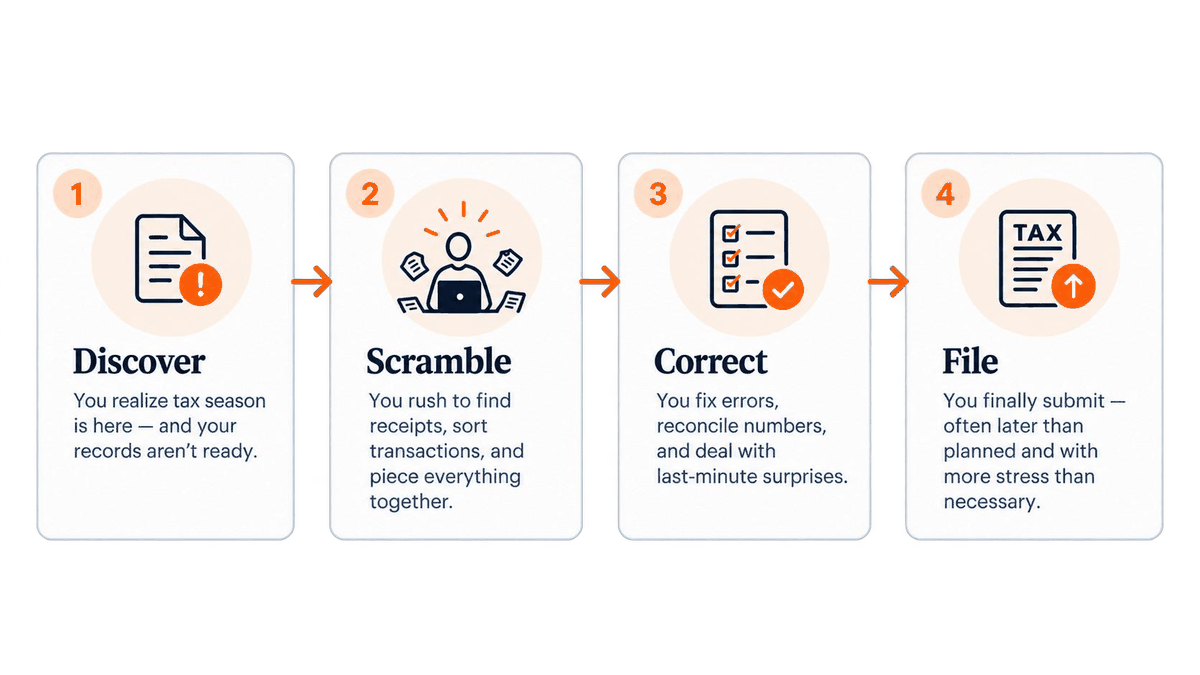
Waiting until the annual deadlines arrive usually produces a very different sequence:
That difference matters because onboarding a new accountant or STR accounting firm is not simply a matter of transferring login credentials.
A strong transition requires time to:
- Understand the existing financial structure
- Review historical books
- Understand the PMS and accounting technology stack
- Identify reconciliation gaps
- Review the chart of accounts
- Understand owner and management-company financial flows
- Document the month-end process
- Clean up outstanding issues
- Operate the new process for several accounting cycles
The objective should be to have the accounting process working before year-end arrives.
That gives the accounting team an opportunity to run a complete month-end close, identify where the process breaks, resolve exceptions, and repeat the workflow before annual reporting and tax deadlines add additional pressure.
When should an STR property manager hire an accountant?
Ideally, before accounting problems become year-end cleanup projects.
Starting several months before year-end gives a short-term rental accountant time to assess historical records, clean up discrepancies, establish reliable financial processes, and run multiple month-end closes before annual reporting begins.
The best time to fix year-end accounting is before year-end starts.
Why STR Accounting Requires STR-Specific Experience
What makes short-term rental accounting different?
Short-term rental accounting combines elements of hospitality, property management, trust accounting, owner reporting, and operating-company finance.
A professional STR property manager may need to account for:
- Guest funds
- Owner funds
- Trust accounts
- Management commissions
- OTA payouts
- Advance deposits
- Cleaning and guest fees
- Reimbursable owner expenses
- Lodging and occupancy taxes
- Owner reserves
- Vendor payments
- Trust-to-operating transfers
- Owner statements
A traditional accountant or bookkeeper may understand accounting extremely well.
The additional challenge in vacation rental accounting is understanding how money actually moves through an STR property management company.
The financial relationship often looks something like this:
Reservations → Cash → Trust liabilities → Expenses → Management revenue → Owners
Each step affects another.
A guest payment may contain rent, cleaning fees, taxes, deposits, and other amounts that ultimately belong to different parties.
An OTA payout may combine multiple reservations while deducting fees.
An owner expense may be paid using one system, recorded in another, reimbursed through a future statement, and reflected differently in the management company's operating books.
Trust funds may need to remain clearly separated from management-company funds.
That is why STR bookkeeping is not simply a matter of categorizing bank transactions correctly.
Why use an accountant who specializes in short-term rentals?
STR property management introduces financial workflows that many traditional businesses do not have, including owner funds, trust accounting, OTA payouts, owner statements, lodging taxes, management commissions, and property-level expense allocation.
The benefit of using an STR accounting firm is not simply that the accountant understands industry terminology. It is that your team spends less time explaining how the business works before the accountant can determine how the accounting should work.
Specialization shortens the learning curve between the operational reality of the business and the financial records that are supposed to represent it.
STR-Specific Accounting Shouldn't Require a New Tech Stack
One of the concerns property managers may have about changing accounting providers before year-end is that doing so will force them to change everything else at the same time.
It should not.
Working with an accounting firm that specializes in short-term rentals does not necessarily mean replacing the systems your company already uses. A technology-flexible STR accounting partner should be capable of understanding and working across the financial systems already supporting your operation.
STR-Specific Accounting Software
Some operators use purpose-built STR accounting software for trust accounting, owner accounting, reconciliation, financial management, or owner reporting. These platforms can play an important role in the accounting process, but the software itself does not replace the need for reliable accounting controls and consistent financial processes.
General Accounting Software
Many property managers use general accounting platforms such as QuickBooks Online, Sage Intacct, or other general ledger systems. The right accounting setup depends on the size, complexity, reporting requirements, and existing financial structure of the business.
An STR accounting firm should understand how to operate within those environments where appropriate.
PMS Accounting and Reporting Tools
Many property management systems include financial functionality related to reservations, owner statements, fees, payments, and reporting. Your accountant needs to understand both what information originates in the PMS and how that information ultimately connects to the accounting records.
Property Management Systems
The PMS frequently acts as an important source of financial data. Reservation activity, property assignments, owner information, fees, guest charges, and other transaction data may all originate there.
That makes PMS accounting and the connection between the PMS and the broader financial process critical.
Cleaning and Turnover Platforms
Cleaning, maintenance, and turnover systems can generate expenses that need to be associated with specific properties, reservations, or owners.
Those costs may affect reimbursable expenses, owner statements, property-level reporting, and vendor accounting.
Online Travel Agencies (OTAs) & Payment Processors
Guest payments, refunds, direct bookings, owner transactions, deposits, and payment-processing fees all create accounting activity. The accounting process needs to connect what was charged to what was actually deposited and ultimately recorded.
Different OTAs have different payout methods... understanding how the money is being paid out, and what your responsibilities are as a property manager, is important expertise a STR specific accounting firm should be able to help you with.
Corporate Cards and Expense Management
Property-level purchases, employee spending, receipts, reimbursements, and operational expenses often flow through corporate cards or expense management platforms. Those
systems need to connect cleanly to the bookkeeping process so costs are categorized appropriately and reimbursable expenses do not fall through the cracks.
Revenue Management Systems
Revenue management platforms may contribute to property-level pricing and performance data that support broader financial analysis. They are not accounting systems, but they may form part of the financial data environment used by the operator.
Banking, AP, and Payment Infrastructure
Bank accounts, accounts payable systems, vendor payment tools, trust accounts, operating accounts, and other payment infrastructure all contribute to the financial workflow. An accounting partner needs to understand how those systems interact rather than evaluating each one in isolation.
Do I need to change my accounting software when hiring an STR accounting firm?
Not necessarily.
An STR-specific accounting firm should be able to evaluate and work within an operator's existing financial and operational technology where appropriate, rather than requiring a specific software platform simply to provide accounting services.
There may be situations where changing systems would materially improve the accounting process. Those changes should be recommended intentionally based on operational requirements, not treated as a prerequisite for changing accounting providers.
Can an STR accountant work with my existing PMS?
A technology-flexible STR accounting firm should be able to work with financial data from different PMS platforms and connect that information to the operator's broader accounting, banking, payments, expense management, and reporting processes.
The accountant's job is to understand the financial logic moving through the technology, not simply one specific piece of software.
The Accounting Process Should Connect the Stack
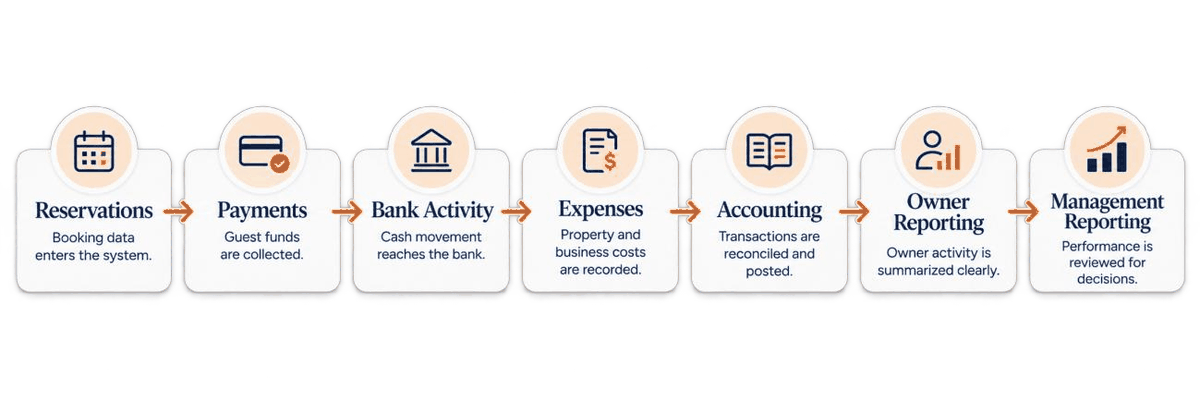
Technology stacks vary significantly between STR operators. The underlying financial controls should not. A reliable accounting process should connect:
It should not require:
The goal is not to create the theoretically perfect technology stack on day one. The goal is to make sure the financial information already moving through your existing property management technology stack is being captured, reconciled, and reported correctly.
That means understanding where financial data originates, where it moves, which system is considered authoritative, and how discrepancies are identified and resolved.
Specialized Expertise Without Software Lock-In
An STR accounting firm should understand the financial logic behind the technology, rather than depending on one specific platform to make the accounting work.
That could mean supporting:
- An operator using dedicated vacation rental accounting software
- A PMC running its corporate accounting through QuickBooks Online
- A larger operator using Sage or another general ledger
- A business relying heavily on PMS accounting functionality
- An operator with financial data distributed across several systems
Sometimes the existing technology creates unnecessary limitations. In those situations, changing software may make sense. But those recommendations should follow an assessment of the financial process. They should not come first.
Changing accounting partners should not automatically require changing your technology.
Why This Matters Before Year-End
This flexibility significantly reduces the barrier to improving the accounting process before year-end.
Operators should not need to spend the fall simultaneously:
- Migrating accounting providers
- Replacing their PMS
- Changing accounting software
- Rebuilding integrations
- Retraining their team
- Cleaning up the books
A more practical sequence is:
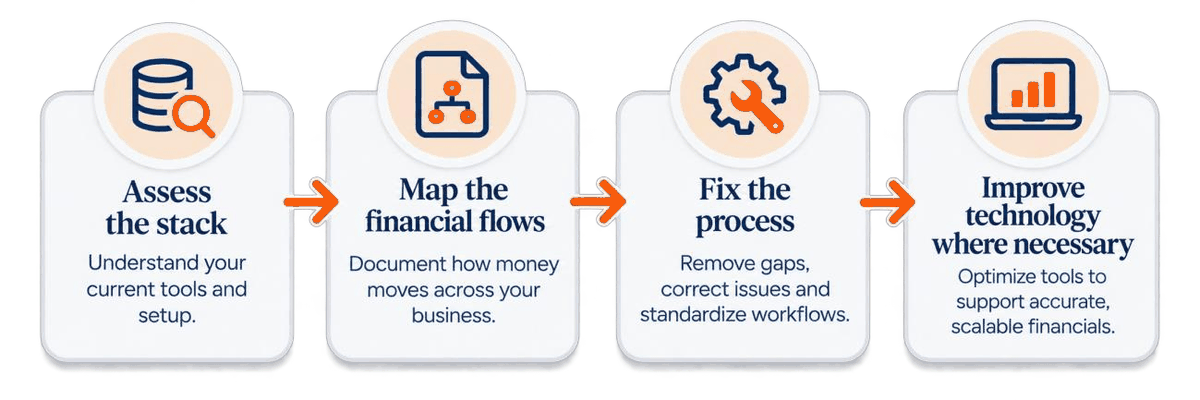
You don't need to rebuild your tech stack before year-end. You need to make sure the financial process running through it actually works.
The STR Financial Workflow Your Accounting Partner Needs to Understand
Short-term rental accounting is not simply a bank reconciliation or a general ledger. Your accounting partner needs to understand the full financial workflow across the property management business. A simplified STR financial workflow might look like this:
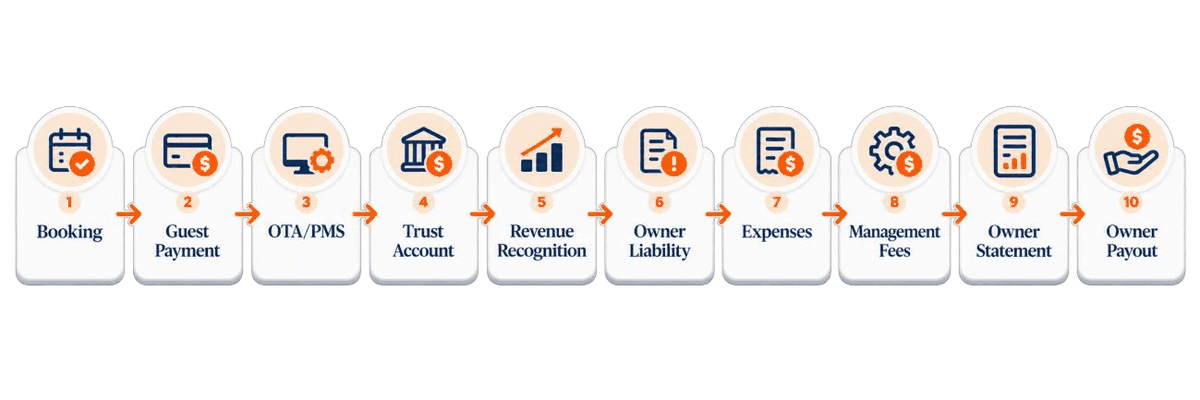
At the same time, the management company's own operating accounting follows a separate but connected workflow:
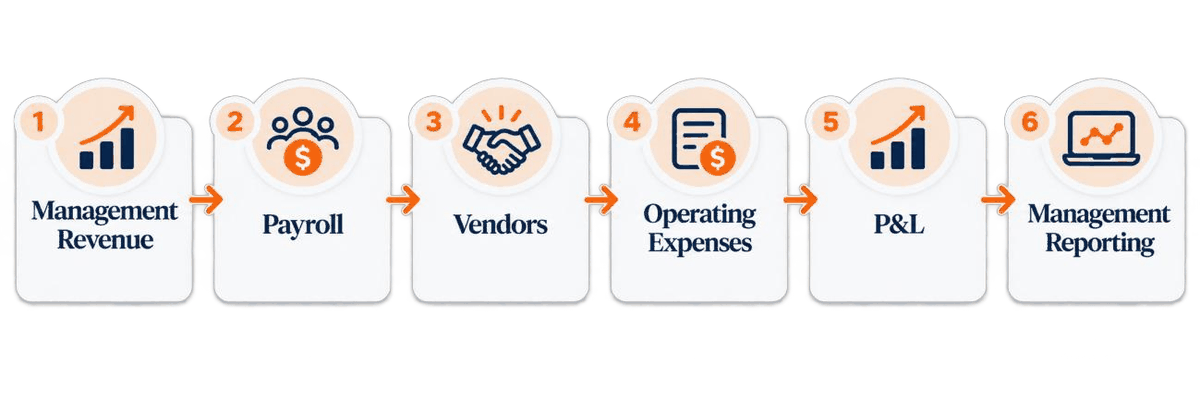
These flows interact, but they are not interchangeable. Owner funds and management-company funds need to be accounted for correctly. Management fees need to move from one side of the financial structure to the other appropriately. Property expenses need to reach the correct owner or operating account. Trust liabilities need to be supported by the cash and obligations they represent. Owner statements need to align with the underlying accounting activity.
Why is STR accounting different from traditional bookkeeping?
STR accounting must account for the relationship between guest transactions, owner funds, management-company revenue, OTA payouts, property-level expenses, trust liabilities, and owner reporting.
That interconnected financial workflow is what makes accounting for vacation rental property managers fundamentally different from simply maintaining the books for a traditional operating business.
What You Should Have Clean Before December
The months before year-end are an opportunity to identify what is already working and clean up what is not. Property managers should aim to have the following areas under control before December.
Trust and Bank Accounts
- Accounts reconciled through the latest completed month
- Outstanding discrepancies identified
- Trust balances supported by corresponding liabilities
- Unexplained transfers investigated
- Differences between expected and actual cash positions understood
- Trust-to-operating transfers properly documented
Trust accounting for vacation rentals becomes increasingly difficult to investigate when unresolved discrepancies carry forward from month to month. A difference found today is easier to understand than the same difference buried underneath several additional months of activity.
Bookkeeping
- Transactions categorized consistently
- Balance sheet accounts reviewed
- Revenue recorded appropriately
- Duplicate or unexplained transactions resolved
- Bank accounts reconciled
- Credit cards reconciled
- Suspense or clearing accounts reviewed
- Historical adjustments documented
Consistent STR bookkeeping makes year-end easier because the books have already been reviewed throughout the year.
Owner Accounting
- Owner statements reconcile
- Owner balances are accurate
- Reimbursable expenses are accounted for
- Management fees and commissions are correctly recorded
- Owner reserves are understood
- Other owner liabilities are supported
- Outstanding owner charges have been investigated
Vacation rental owner statements should reflect the underlying accounting activity, not operate as a separate financial reality that needs to be reconciled later.
Tax Readiness
- Lodging and occupancy tax records are organized
- W-9 information is collected where required
- Vendor and owner reporting data has been reviewed
- Prior filing discrepancies have been identified
- Responsibilities across OTA and direct bookings are understood
- Supporting records can be retrieved easily
This does not mean completing year-end tax work months early. It means making sure the financial information required for year-end reporting will be available when it is needed.
Operational Accounting
- The chart of accounts reflects the business
- Property-level reporting is available where required
- Month-end responsibilities are documented
- Close deadlines are established
- Ownership of each accounting task is clear
- Financial information flows between systems are understood
- Exceptions have an established resolution process
What should STR property managers do before year-end?
STR property managers should reconcile bank and trust accounts, review owner liabilities, clean up bookkeeping, verify owner statements, organize tax information, review vendor reporting information, and establish a consistent month-end close before December.
The goal is to enter year-end with known financial information rather than a growing list of questions.
What Happens When You Wait Until Year-End
Waiting until December or January does not necessarily create new accounting problems. It makes existing problems harder to investigate. A late cleanup project may require the accounting team to review an entire year of:
- Historical transactions
- Payout discrepancies
- Missing receipts
- Owner charges
- Tax records
- Unexplained transfers
- Reimbursements
- Incorrectly categorized revenue
- Incorrectly categorized expenses
- Balance sheet discrepancies
The problem is not merely the volume of work. Context disappears over time. A strange transaction from last week may still be familiar to the employee who made the purchase. Six months later, that same transaction may require searching through emails, receipts, payment systems, and property records just to determine what happened.
A missing reimbursable owner expense is easier to correct before months of owner statements have already been issued.
An OTA payout discrepancy is easier to trace before hundreds of additional reservations have flowed through the same account.
A trust reconciliation issue is easier to understand before the balance has moved repeatedly through later accounting periods.
Continuous accounting processes reduce that risk because problems are investigated while the supporting context is still available. That is why strong year-end accounting starts with a reliable STR month-end close.
What the First 90 Days with an STR Accounting Partner Should Look Like
Changing accounting providers before year-end should not simply mean replacing one bookkeeping service with another. The first 90 days should create a more reliable financial operating process.
Month 1: Assess and Clean
The first month should focus on understanding what already exists.
That may include:
- Understanding the existing accounting process
- Mapping the existing technology stack
- Reviewing financial systems
- Reviewing historical books
- Identifying reconciliation gaps
- Identifying historical issues
- Establishing reliable opening balances
- Prioritizing cleanup
- Identifying immediate year-end risks
- Understanding trust and operating cash flows
- Reviewing owner accounting processes
The objective is not to redesign everything immediately. It is to understand where the current process is accurate, where it breaks, and which issues could create problems at year-end.
Month 2: Build and Standardize
Once the current environment is understood, the accounting partner can begin establishing a repeatable process.
That may include:
- Establishing recurring workflows
- Standardizing transaction categorization
- Documenting reconciliation processes
- Improving owner reporting
- Establishing month-end responsibilities
- Clarifying close deadlines
- Connecting financial workflows across existing systems
- Improving reimbursable expense accounting
- Establishing processes for handling exceptions
- Creating more consistent management reporting
The goal is to move financial activity through the business the same way every month.
Month 3: Operate and Refine
By the third month, the process should move from design into operation.
That includes:
- Running a complete month-end close
- Resolving remaining exceptions
- Measuring close timing
- Reviewing management reporting
- Reviewing owner reporting
- Refining processes that created friction
- Confirming reconciliations
- Preparing for year-end requirements
At this point, the accounting team has had an opportunity to operate the process rather than simply document it. Problems can still be corrected before annual deadlines arrive. Then December becomes another close, not an accounting rescue mission.
Signs You Should Make the Change Before Year-End
Not every accounting issue means a property manager needs to change providers. But recurring problems can indicate that the underlying accounting process needs attention.
Consider reviewing your short-term rental accounting setup before year-end if:
- Month-end consistently runs late
- You do not completely trust your financial statements
- Owner statements regularly require manual fixes
- Your accountant frequently needs you to explain how STR transactions should be handled
- Trust reconciliation requires extensive manual spreadsheets
- You cannot easily see profitability at the level your business requires
- Your bookkeeping is already behind
- Tax preparation creates significant cleanup every year
- Your portfolio has grown but your accounting process has not
- Too much financial knowledge lives with one employee
- Reimbursable expenses regularly fall through the cracks
- Your PMS, accounting platform, and bank activity do not consistently agree
- Balance sheet accounts carry unexplained balances
- Owner liabilities are difficult to validate
- You have avoided changing accounting providers because you assume you will also need to replace your PMS, accounting software, or operational systems
One isolated problem can usually be solved. A recurring pattern is more important. If the same accounting problems return every month, the issue may be the process rather than the individual transaction.
What to Look for in an STR Accounting Firm
Choosing an STR accounting firm should involve more than comparing bookkeeping prices. The provider needs to understand the financial structure of a professional vacation rental property management company.
What should I look for in an STR accounting firm?
Look for a firm that understands:
- STR-specific trust accounting
- Your PMS and reservation data
- OTA payout structures
- Owner statements
- Management commissions
- Lodging and occupancy taxes
- Property-level reporting
- Operational accounting
- Month-end close
- Reimbursable expenses
- Multi-entity structures
- Scalable financial processes
The accounting team should be able to follow money from the reservation through settlement, trust accounting, owner liability, expense allocation, management revenue, reporting, and payout.
Technology Flexibility
Technology compatibility should also be part of the evaluation.
Ask:
Can they work effectively across your existing PMS, accounting platform, banking, payments, expense management, and operational systems, or do they require you to adopt their preferred stack?
An STR accounting integration does not necessarily need to mean a custom technical integration. In many cases, the more important question is whether the accountant understands how data moves between the systems and can establish reliable processes for reconciling them.
You should also consider whether you are simply buying bookkeeping labor or gaining a financial partner capable of improving the underlying process as the company grows. An accounting provider can record transactions. A stronger financial partner should also be able to identify why the same discrepancies continue occurring and help improve the process that creates them.
The Goal Isn't Just a Cleaner Year-End
Year-end creates the deadline. It should not be the only reason to improve the accounting process.
The larger opportunity is:
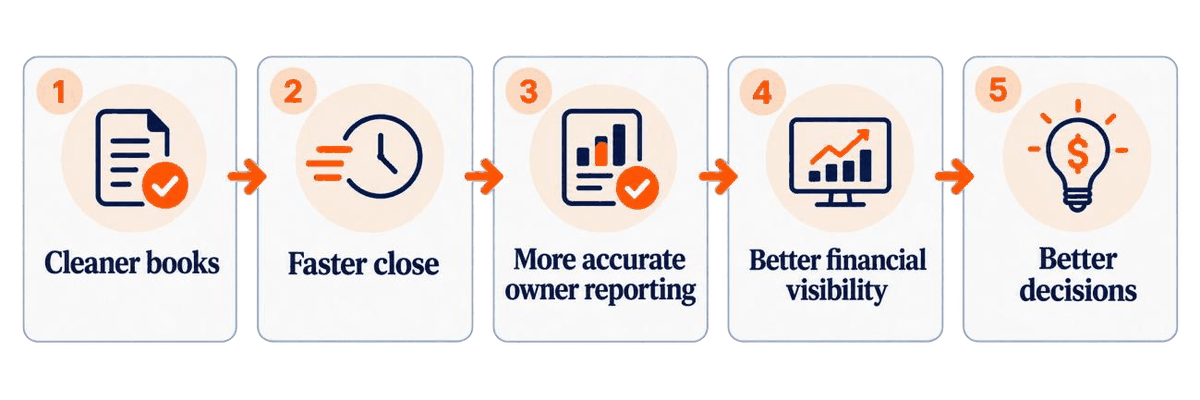
A stronger accounting process should make January easier. But it should also make February easier. And June. And September.
A property manager should be able to understand the financial position of the business without waiting for year-end cleanup. Owners should receive financial information that can be supported by the underlying accounting records. Management should be able to
evaluate operating performance using financial statements they trust. The accounting team should know what needs to happen every month, who owns each responsibility, and how discrepancies are handled.
Year-end simply provides a useful deadline for getting there. Year-round financial clarity is the actual outcome.
Don't Wait Until December to Discover What Needs Fixing
If your STR accounting process already feels difficult in the fall, adding annual reporting, tax preparation, 1099s, year-end reconciliations, and historical cleanup will not make it simpler. The months before year-end give property managers something far more valuable than a last-minute cleanup.
They provide time to build the right process.
Get the books clean.
Get the workflows documented.
Run the process.
Fix what does not work.
Make sure trust accounting, owner accounting, STR bookkeeping, and management-company financial reporting are working together. And do not assume doing that requires replacing the technology your operation already depends on.
A capable STR accounting firm should be able to evaluate the systems you already use, understand the financial workflows running through them, and recommend technology changes only where those changes materially improve the process.
Then, when year-end arrives, you are closing the year instead of rebuilding it.
A clean year-end is built before year-end.
If you're unsure whether your current accounting process is ready for year-end, HostAllies can review your existing financial operation, work within your current technology stack, identify the gaps, and help establish a cleaner financial process before the year closes.
Book a consultation with HostAllies today!